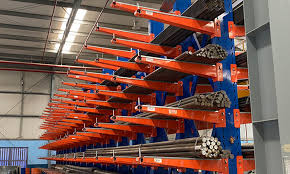
Future Trends in Warehouse Racking – Automation and Smart Storage in UAE

The logistics and warehousing industry in the UAE is evolving faster than ever. With the growth of e-commerce, manufacturing, and global trade, warehouses across Dubai, Sharjah, Abu Dhabi, and Ajman are under pressure to move goods faster, safer, and more efficiently.
This demand has given rise to smart warehouse racking systems, driven by automation, AI, and advanced storage technologies that are reshaping how goods are stored and handled in modern UAE warehouses.
1. From Traditional to Smart Racking Systems
In the past, most warehouses in the UAE used manual pallet racking systems — strong, simple, and cost-effective. But as space became more expensive and labor costs increased, warehouse operators began turning to automated storage systems that could maximize space and speed up operations.
Today, smart racking systems integrate sensors, robotics, and artificial intelligence (AI) to improve accuracy, safety, and efficiency. These systems can automatically locate, store, and retrieve items with minimal human intervention.
2. The Rise of ASRS (Automated Storage and Retrieval Systems)
ASRS, short for Automated Storage and Retrieval System, is one of the biggest technological changes in modern warehousing. It uses robotic shuttles, cranes, or lifts that move along dedicated tracks within the racking system to store or retrieve pallets or bins automatically.
Key benefits of ASRS in UAE warehouses:
- Higher storage density: Maximizes vertical and horizontal space.
- Faster picking speeds: Robots work continuously with precision.
- Reduced labor costs: Less manpower is needed for repetitive lifting or moving.
- Improved safety: Fewer forklifts and manual operations reduce accidents.
Companies operating in UAE free zones, such as Jebel Ali, KIZAD, and Sharjah Industrial Area, are beginning to adopt ASRS to improve their logistics efficiency and meet global standards.
3. Integration of Artificial Intelligence (AI)
AI is transforming warehouse racking systems from simple steel structures into smart data-driven environments. AI algorithms help analyze storage patterns, predict demand, and optimize space usage.
Examples of AI use in warehouse racking:
- Smart slotting: AI predicts which products move fastest and assigns them optimal rack positions.
- Predictive maintenance: Sensors detect when racks or equipment need service before breakdowns occur.
- Energy optimization: AI adjusts lighting and automated systems based on usage and activity levels.
For UAE companies in logistics, retail, and manufacturing, this means better productivity and lower costs — two major advantages in a competitive market.
4. IoT and Real-Time Tracking
The Internet of Things (IoT) connects racks, forklifts, and storage sensors into one intelligent network. Each rack or storage bay can be equipped with RFID tags or smart sensors that report the exact location and status of goods.
This real-time visibility helps warehouse managers:
- Track stock levels instantly.
- Reduce misplaced or lost items.
- Monitor temperature and humidity for sensitive goods.
- Improve decision-making through live data dashboards.
IoT-driven racking is especially useful in cold storage, pharmaceuticals, and food distribution warehouses across Dubai and Abu Dhabi, where precision and traceability are critical.
5. Modular and Scalable Racking Designs
Future racking systems in the UAE are moving toward modular, scalable designs that can easily adapt to growth. Instead of dismantling an entire system, businesses can add or reconfigure racks as inventory or automation needs change.
This flexibility is particularly valuable for fast-growing e-commerce warehouses in Sharjah, Ajman, and Ras Al Khaimah.
6. Sustainability in Smart Racking
Sustainability is becoming a top priority in UAE construction and logistics. Modern racking systems now use:
- Recycled steel materials for lower carbon footprints.
- Energy-efficient ASRS and robotics to reduce power consumption.
- Compact storage layouts to minimize warehouse cooling or lighting requirements.
By combining green building practices with smart automation, warehouses in the UAE can align with the country’s Net Zero 2050 goals.
Conclusion
The future of warehouse racking in the UAE is smart, automated, and data-driven. From AI-powered optimization to robotic retrieval systems, innovation is transforming storage efficiency across Dubai, Sharjah, Ajman, and beyond.
Companies investing in automated and intelligent racking solutions today are preparing for a future where speed, safety, and sustainability define warehouse success.
At Sama Racking UAE and Moazzam Ali Building Material Trading, we provide modern racking solutions, I-beams, decking, and customized storage systems designed to support automation and heavy-duty performance — built for the UAE’s industrial future.
Frequently Asked Questions (FAQ)
1. What is a smart warehouse racking system?
A smart warehouse racking system uses automation, sensors, and AI to manage storage more efficiently. It can automatically store, locate, and retrieve goods using robots or automated cranes, reducing manual work and increasing accuracy.
2. What does ASRS mean, and how does it work?
ASRS (Automated Storage and Retrieval System) is a technology-driven storage solution where machines handle material movement within racking structures. It uses robotic shuttles or cranes that operate along rails to store or pick items without human intervention.
3. Why are automated racking systems becoming popular in the UAE?
With warehouse space and labor costs rising in the UAE, businesses in Dubai, Sharjah, and Abu Dhabi are choosing automated and AI-based racking to increase efficiency, reduce errors, and make better use of vertical space.
4. Can existing UAE warehouses be upgraded to smart systems?
Yes. Most existing warehouses can be retrofitted with sensors, automation, and tracking systems without full reconstruction. Modular racking and IoT devices make it easy to convert traditional storage into a smart warehouse.
5. What are the main benefits of automation in warehouse racking?
- Improved storage density and space utilization
- Faster picking and order fulfillment
- Lower operational costs
- Reduced safety risks for workers
- Real-time inventory visibility and tracking
6. Is smart warehouse racking suitable for all industries?
Yes. Smart racking can be adapted for e-commerce, logistics, manufacturing, food storage, and pharmaceuticals. The system can be customized depending on product size, weight, and handling needs.
7. How does AI improve warehouse operations?
AI analyzes data from sensors and systems to predict demand, optimize stock locations, and prevent equipment failure. It also helps allocate resources automatically, leading to smoother, faster operations.
8. What is the average cost of installing an automated racking system in the UAE?
Costs vary based on design, height, and automation level. A standard ASRS or smart racking system can start from AED 500–1000 per pallet position, depending on capacity and technology. Customized quotations are available from suppliers like Sama Racking UAE and Moazzam Ali Building Material Trading.
9. How does smart racking contribute to sustainability?
Smart racking systems reduce power use, optimize lighting, and minimize wasted space. Many UAE warehouses now use recycled steel materials and energy-efficient automation to support the nation’s Net Zero 2050 vision.
10. Where can I find reliable racking suppliers in UAE?
You can contact Sama Racking UAE or Moazzam Ali Building Material Trading (MABMTR) for certified racking systems, I-beams, decking, and custom warehouse designs.
📞 0544812988 | 🌐 samaracking.ae | samaracking.ae