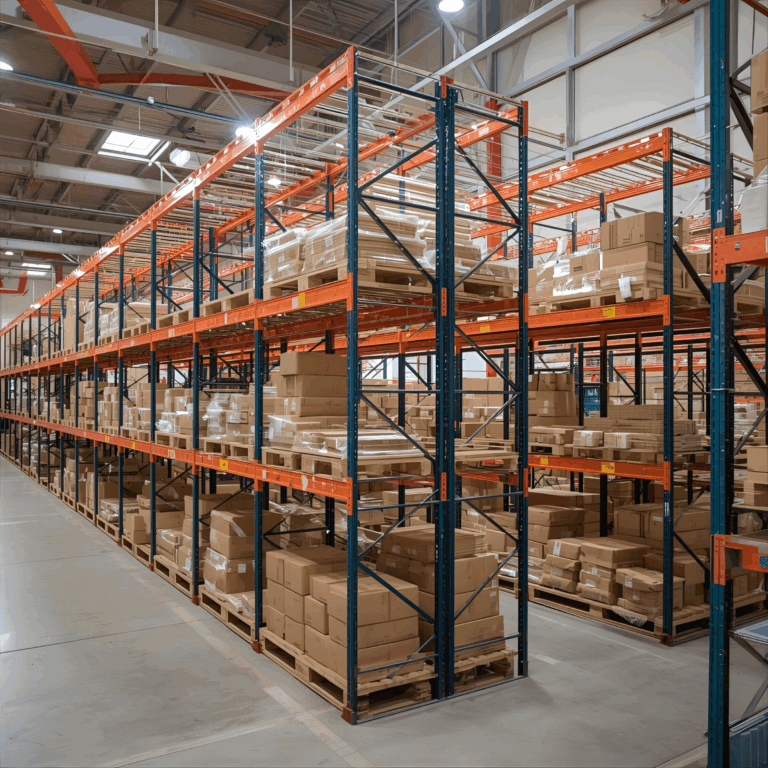
Heavy Duty Racking Complete Guide for Dubai, Abu Dhabi & Sharjah Warehouses
If you manage a warehouse in the UAE — whether it sits inside a Dubai free zone, a Mussafah industrial plot in Abu Dhabi, or a Sharjah manufacturing corridor — you already know that floor space costs money. A lot of it. And in a market where every square meter of covered warehouse space commands a premium, maximizing vertical storage is not just smart. It is essential.
That is exactly where heavy duty racking systems come in. A well-designed racking installation transforms a cluttered, under-utilised warehouse floor into an organised, efficient, and scalable operation. In this guide, we break down everything UAE business owners and logistics managers need to know — from the different types of racking available to how the installation process works across the seven emirates.
💡 Sama Racking has completed over 1,200 warehouse projects across Dubai, Abu Dhabi, Sharjah, Ajman, Ras Al Khaimah, Fujairah, and Al Ain. Free site surveys available UAE-wide.
What Is a Heavy Duty Racking System?
A heavy duty racking system is a structured steel storage framework designed to hold large, heavy loads — typically palletised goods — at multiple levels within a warehouse. Unlike standard office or retail shelving, industrial racking systems are engineered to precise load ratings, must comply with international structural standards, and are anchored to warehouse floors to ensure stability.
In the UAE context, heavy duty racking refers broadly to any system rated above 500 kg per shelf level and designed for use with forklifts, reach trucks, or pallet jacks. These systems form the backbone of distribution centres, manufacturing plants, cold stores, and logistics hubs from Jebel Ali to KIZAD.
Why UAE Warehouses Need Heavy Duty Solutions
The UAE’s logistics sector is one of the most dynamic in the world. Dubai’s Jebel Ali Port — the largest port in the Middle East — processes millions of containers annually, and Abu Dhabi’s industrial zones continue to attract global manufacturers and distributors. This growth creates enormous demand for efficient, high-density warehouse storage.
Beyond sheer volume, UAE warehouses face specific operational pressures: high ambient temperatures that affect both goods and workers, strict municipality safety regulations, demanding throughput requirements in free zones like SAIF Zone and Hamriyah, and the constant pressure to do more with less space as rental costs climb.
💡 Heavy duty racking is not a one-size-fits-all purchase. The right system for a pharmaceutical cold store in Dubai Healthcare City is very different from what works in a tyres warehouse in Sharjah Industrial Area.
Types of Heavy Duty Racking Systems Available in UAE
1. Selective Pallet Racking — The UAE Workhorse
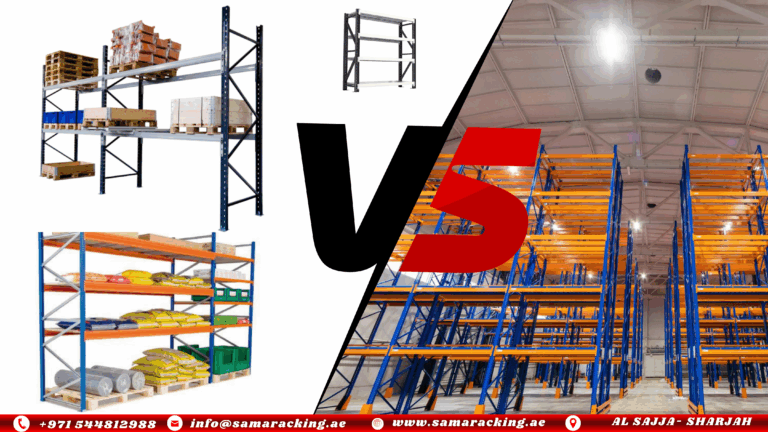
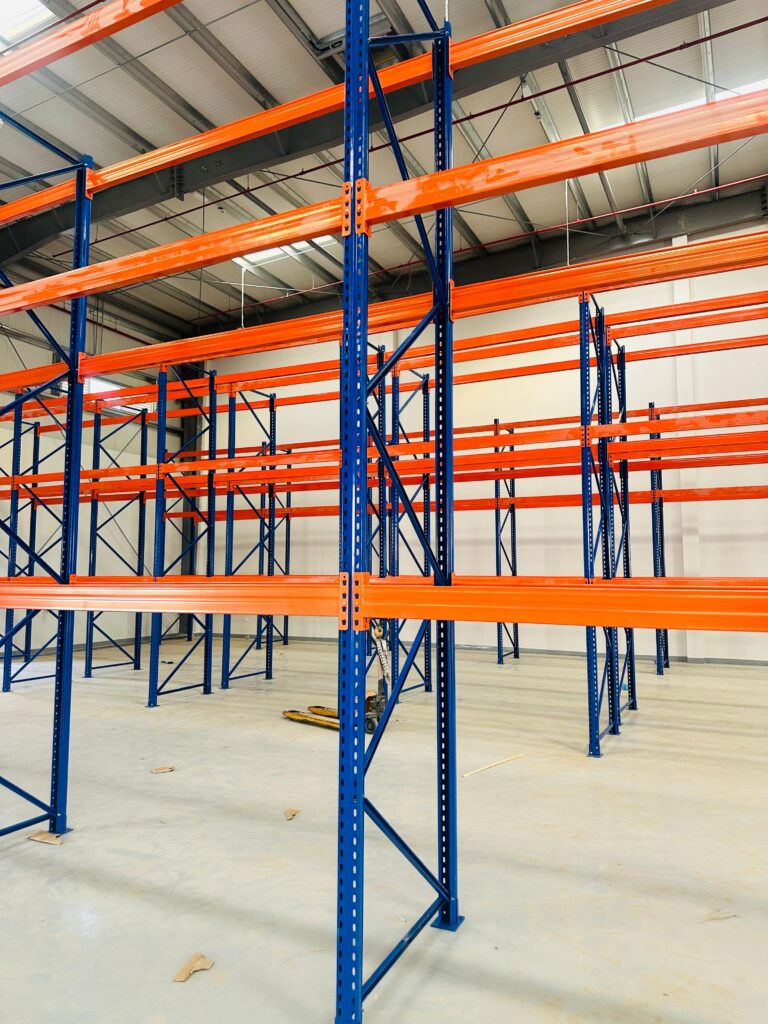
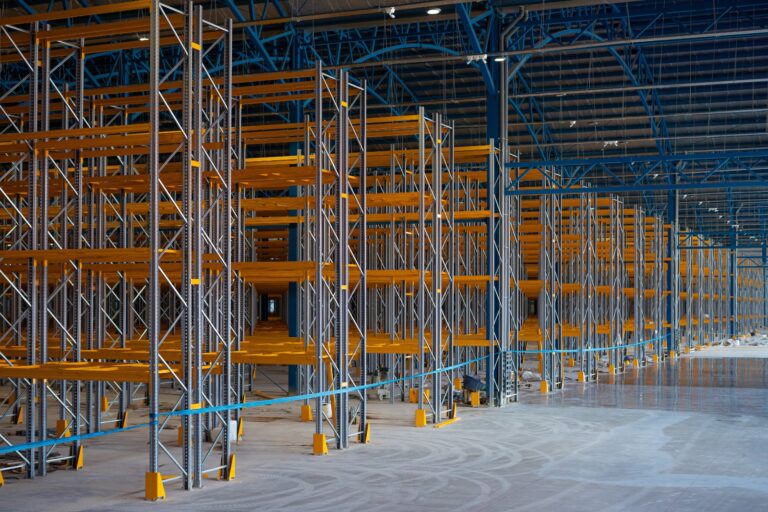
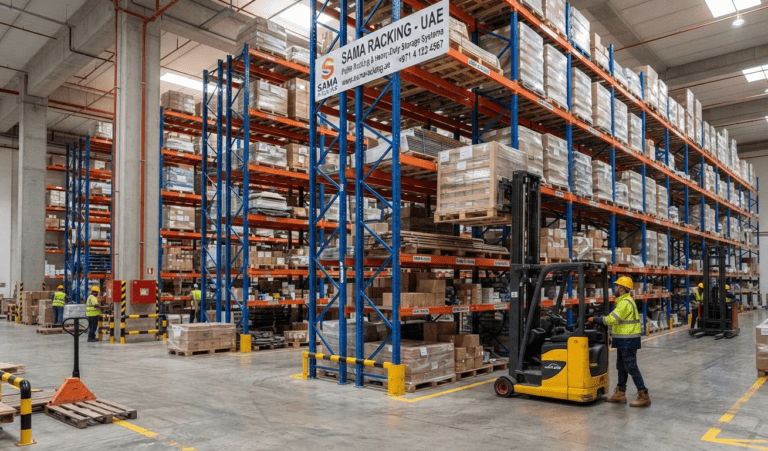
Selective pallet racking is by far the most widely used storage system in UAE warehouses. Its name says it all: every single pallet is directly accessible without moving another. Rows of upright frames are connected by horizontal beams, and pallets sit on beam pairs at whatever height your forklift can reach.
- Immediate access to every pallet — ideal for FIFO stock management
- Highly configurable; bay widths and beam heights can be adjusted
- Works with any standard forklift, reach truck, or pallet jack
- Load capacity typically ranges from 1,000 kg to 6,000 kg per level
- The most cost-effective racking type per pallet stored
For most Dubai and Abu Dhabi warehouses handling a wide variety of SKUs, selective pallet racking delivers the best balance of accessibility, flexibility, and price. It is the natural starting point for any racking project.
2. Drive-In and Drive-Through Racking — Maximum Density
When floor space is at a premium and you are storing large quantities of the same product, drive-in racking dramatically increases your storage density. Instead of each pallet having its own aisle access, forklifts actually drive inside the racking structure to place and retrieve pallets on internal guide rails.
Drive-in systems operate on a Last In, First Out (LIFO) basis — the last pallet stored is the first retrieved — making them ideal for products that do not have a tight expiry rotation. Drive-through systems, which have entry points at both ends, allow First In, First Out (FIFO) management.
💡 Drive-in racking can increase your storage capacity by up to 85% compared to selective racking in the same floor area. Popular in cold stores and beverage warehouses across Dubai and Abu Dhabi.
3. Cantilever Racking — Built for Long and Awkward Loads
If your warehouse stores timber, steel bars, pipes, aluminium profiles, carpets, or furniture, standard pallet racking simply does not work. Cantilever racking removes all front columns, replacing them with horizontal arms that extend outward from a central spine. This open-fronted design means you can slide long items in from any point along the length of the rack.
- Arms available in single and double-sided configurations
- Individual arm loads typically range from 500 kg to 1,500 kg
- Column heights available up to 8 metres for UAE high-bay facilities
- Extremely popular in UAE building materials, steel trading, and timber sectors
4. Mezzanine Floors — Double Your Usable Space
A mezzanine floor is a free-standing intermediate level installed inside an existing warehouse, effectively creating a second storey within your building without the cost of a structural extension. For warehouses in high-rent zones like Al Quoz in Dubai or Mussafah in Abu Dhabi, a mezzanine can be a transformative investment.
Modern mezzanine floors are engineered to carry loads of 500 to 1,000 kg per square metre and can span large open areas with minimal supporting columns. They can be fitted with staircases, pallet gates, safety barriers, and conveyor integrations. All mezzanine installations in the UAE require compliance with Dubai Municipality or Abu Dhabi DM structural approval processes — our team handles this paperwork as part of every project.
5. Push-Back Racking — High Density with FIFO Flow
Push-back racking stores pallets on inclined rails with rolling carts. When a new pallet is loaded at the front, it gently pushes the previous pallet back along the rail. When the front pallet is removed, the next one rolls forward automatically under gravity. This gives you two to five pallet positions deep per lane, with significantly better density than selective racking, while still maintaining front-access for your forklifts.
6. Industrial Longspan Shelving — For Cartons and Small Parts
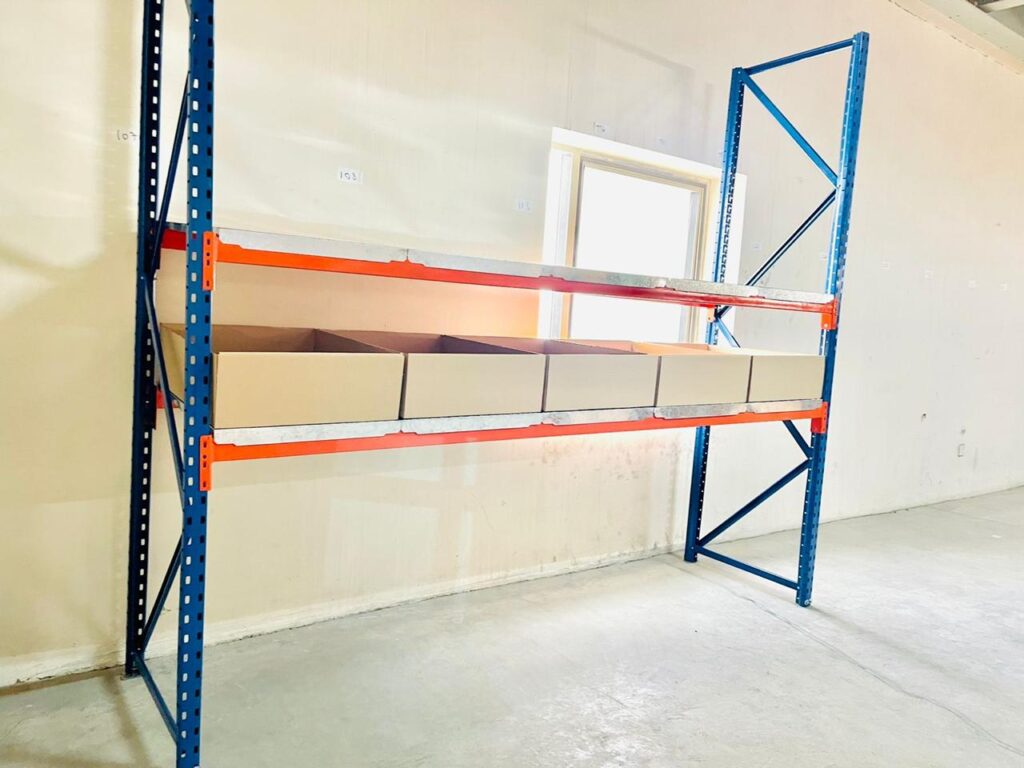
Not everything needs to be palletised. Longspan shelving systems handle goods from 50 kg to 500 kg per shelf level — carton goods, spare parts, e-commerce fulfilment stock, archived documents, and retail back-of-house inventory. Available in boltless (rivet-together) and bolted configurations, longspan shelving is the workhouse of UAE spare-parts operations, pharmacies, and consumer goods warehouses.
UAE Location Guide: Heavy Duty Racking Solutions by Emirate
One of the most common questions we receive is: ‘Do you cover my area?’ The answer, without exception, is yes. Here is a brief overview of how we serve each part of the UAE.
Heavy Duty Racking in Dubai
Dubai is our busiest market, and for good reason. With the world’s largest man-made harbour at Jebel Ali, the massive logistics parks at Dubai Investments Park (DIP), the thriving trade hub of Ras Al Khor, and specialised free zones like Dubai Airport Free Zone (DAFZA) and Dubai Silicon Oasis, the demand for high-performance warehouse racking is constant and growing.
We have active installation teams permanently based to serve Dubai, and carry large stock of standard racking components at our Sharjah hub — which means fast turnaround for Dubai projects. Most standard selective pallet racking installations in Dubai are delivered and installed within five to seven working days of order confirmation.
Heavy Duty Racking in Abu Dhabi
Abu Dhabi’s industrial heartland stretches from Mussafah Industrial Area and ICAD (Industrial City of Abu Dhabi) to the vast Khalifa Industrial Zone (KIZAD) near the Khalifa Port. These are home to some of the largest warehouses and distribution facilities in the region, many serving government entities, ADNOC supply chains, and global manufacturers.
Projects in Abu Dhabi often require closer coordination with municipality technical departments for structural approvals — particularly for mezzanine floors and tall racking structures above six metres. Our Abu Dhabi project team handles all technical submissions as a standard part of the service. Al Ain industrial clients are equally well served, with dedicated site visits and competitive lead times.
Heavy Duty Racking in Sharjah
Sharjah is home to the UAE’s densest concentration of small and mid-sized manufacturing businesses, particularly in its various industrial areas, the Sharjah Airport International Free Zone (SAIF Zone), and Hamriyah Free Zone. These facilities typically require practical, cost-effective racking solutions that can be installed quickly with minimal disruption to ongoing operations.
Because our central stocking warehouse is located in Sharjah, our response times for Sharjah clients are among the fastest in the market. Same-day or next-day site surveys are frequently possible, and we hold strong stock of the most popular racking configurations.
Heavy Duty Racking in Northern Emirates: Ajman, RAK, Fujairah and Umm Al Quwain
The northern emirates are growing rapidly as businesses seek more affordable industrial space relative to Dubai and Abu Dhabi. Ajman Free Zone, Ras Al Khaimah Investment Authority (RAKIA), and Fujairah Free Zone are all attracting serious warehouse investment. Our installation teams cover all northern emirate locations, and we regularly complete projects in RAK’s ceramics and building materials sector as well as Fujairah’s port-adjacent logistics facilities.
Heavy Duty Racking UAE Safety Standards and Compliance: What You Need to Know
Racking safety is not optional in the UAE. Whether your warehouse sits in a Dubai free zone or an Abu Dhabi industrial plot, your racking must comply with a set of structural, fire, and occupational safety requirements. Failing to meet these can result in municipality stop-work orders, insurance voidance, or — in worst cases — catastrophic rack collapse.
Here is what UAE warehouse managers need to be aware of:
- EN 15512 (European Standard for Steel Static Storage Systems) — the primary structural design standard referenced in UAE racking projects
- FEM 10.2.02 — the design guideline for adjustable pallet racking used alongside EN 15512
- Dubai Municipality Building Code requirements for floor anchor loads and seismic considerations (UAE sits in Seismic Zone 2A)
- SIRA and Civil Defence fire compliance — particularly important for warehouses storing flammable or high-value goods
- Load notices — UAE regulations require visible load capacity signs on every racking bay, stating maximum UDL (Uniformly Distributed Load) and maximum bay load
💡 Every racking system we supply comes with a certified installation report, load notices, and the documentation required for municipality and Civil Defence inspections. We do not cut corners on compliance.
How the Heavy Duty Racking Installation Process Works in UAE
Many first-time racking buyers in the UAE are unsure what to expect. The process is actually quite straightforward when you work with an experienced supplier. Here is how we approach every project:
Step 1: Free Site Survey
Everything starts with a visit to your warehouse. Our engineers bring laser measuring tools, check your floor slab for levelness and load capacity, assess your forklift aisle requirements, and listen carefully to how your operation actually works. We do not sell you what we have in stock — we design what your warehouse needs.
Step 2: CAD Layout and Quotation
Within 48 hours of the site survey, you receive a detailed CAD drawing of your proposed racking layout, complete with beam heights, aisle widths, and bay dimensions. Alongside this, you get a transparent, itemised quotation — materials, delivery, and installation all separately listed so you know exactly what you are paying for.
Step 3: Manufacturing and Delivery
For standard configurations, components ship from our Sharjah stock within three to seven working days. For larger or bespoke projects, we work to an agreed lead time confirmed in writing. All deliveries are coordinated with your site manager to arrive when you are ready.
Step 4: Professional Installation
Our trained installation crews handle everything: floor marking, base plate anchoring, upright erection, beam loading, bracing installation, and safety accessories like column guards and rack-end barriers. We hand over a completed system with full documentation — including load notices — ready for your first forklift.
How to Choose the Right Heavy Duty Racking System for Your UAE Warehouse
With so many options available, choosing the right system can feel overwhelming. Here are the five key questions to answer before making a decision:
- Product Type: What is your product type?
Palletised goods, long items, cartons, and bulk products all call for different racking configurations. Be clear about your primary product format before anything else.
- Number of SKUs: How many SKUs do you manage?
A warehouse with hundreds of different product lines needs direct access (selective racking) to every location. A warehouse with five SKUs in large quantities is a candidate for drive-in or push-back racking.
- Clear Height: What is your warehouse clear height?
UAE warehouses range from five metres to fourteen metres in clear internal height. Taller buildings unlock multi-level racking that dramatically increases capacity. Know your height before budgeting.
- Forklift Equipment: What forklift equipment do you use?
Counterbalance forklifts, reach trucks, and narrow-aisle trucks all require different aisle widths. Your racking layout must be designed around your existing material handling equipment — or vice versa.
- Access Frequency: What are your access frequency requirements?
If you need every pallet accessible every hour, selective racking is right. If 80% of your volume sits in slow-moving bulk storage, a denser system will serve you far better.
💡 Not sure which system is right for your warehouse? Our engineers will assess all five of these factors during a free site survey and give you an honest recommendation — even if that means suggesting a simpler solution than you expected.
The Cost of Heavy Duty Racking in UAE: What to Expect
Racking pricing in the UAE varies significantly depending on system type, load rating, height, quantity, and accessories. We cannot publish a single price list that fits every scenario, but here is a realistic framework to help you budget:
Selective pallet racking for a standard-sized UAE warehouse of 500 to 1,000 square metres typically represents a one-time capital investment. Compared to the cost of renting additional warehouse space, a well-designed racking system almost always delivers a positive return on investment within 12 to 24 months — often faster.
When comparing quotes from racking suppliers in the UAE, always check the following:
- Are the uprights and beams manufactured to EN standards with traceable load ratings?
- Is the installation price inclusive of floor anchors, load notices, and safety accessories?
- Does the quote include a post-installation inspection report?
- What warranty is provided — and is it backed by local after-sales support in UAE?
The lowest quote is rarely the best value. Cheap racking that fails a municipality inspection, or that is installed without proper anchoring, costs far more to fix than the initial saving.
Frequently Asked Questions About Heavy Duty Racking in UAE
Q: Can I install racking myself in a UAE warehouse?
Technically, self-installation is possible for lightweight shelving systems. For heavy duty pallet racking, however, DIY installation is strongly inadvisable. UAE municipality regulations require that structural racking systems be installed by qualified personnel with proper floor anchoring, and the installation must be documented for any subsequent civil defence or insurance inspections. A professional installation is not just safer — it protects your legal compliance.
Q: How long does a Heavy Duty Racking installation take?
A straightforward 20-bay pallet racking installation can typically be completed in one to two days. Larger projects involving 100-plus bays, mezzanine floors, or complex multi-tier systems may run over three to five days. We provide a detailed installation schedule before any work begins so you can plan your warehouse operations accordingly.
Q: Do you supply Heavy Duty Racking for cold stores and freezer rooms in UAE?
Yes. Cold store racking requires special consideration — galvanised or powder-coated components to resist condensation, wider aisle tolerances for insulated forklift tyres, and careful attention to floor flatness. We have completed cold store racking projects across Dubai, Abu Dhabi, and Sharjah for food manufacturers, pharmaceutical distributors, and FMCG logistics operators.
Q: What happens if my Heavy Duty Racking gets damaged by a forklift?
Forklift impact damage is one of the most common racking issues in UAE warehouses. We supply replacement components, upright protectors, and column guards — and we can carry out a post-impact structural inspection to assess whether damaged components need immediate replacement. Never continue using visibly bent or cracked racking components. Contact us for a rapid assessment.
Q: Can you supply used or second-hand Heavy Duty Racking in UAE?
Yes. We maintain a stock of certified pre-owned racking from decommissioned UAE and GCC warehouse projects. All used components undergo a full structural inspection before resale. This is a popular option for businesses in Ajman, RAK, and Fujairah looking for cost-effective solutions without compromising on quality.
Conclusion: Invest in Your Warehouse’s Future
A heavy duty racking system is one of the most impactful investments a UAE warehouse operator can make. The right system — properly designed, correctly installed, and compliant with UAE regulations — transforms how your operation runs. It increases storage capacity, improves picking efficiency, reduces stock loss and damage, and creates a safer environment for your team.
Whether you are fitting out a brand new facility in KIZAD, reorganising a busy distribution centre in Jebel Ali, or making the most of a smaller warehouse in Sharjah Industrial Area, the starting point is always the same: a proper site survey and an honest conversation about what your operation actually needs.
💡 Ready to get started? Contact Sama Racking today for a free site survey anywhere across all 7 emirates. We will visit your warehouse, understand your needs, and provide a detailed CAD layout and quotation — with no obligation and no pressure.
📞 +971-544812988 | ✉ info@samaracking.ae | 🌐 www.samaracking.ae
Dubai · Abu Dhabi · Sharjah · Ajman · Ras Al Khaimah · Fujairah · Al Ain