
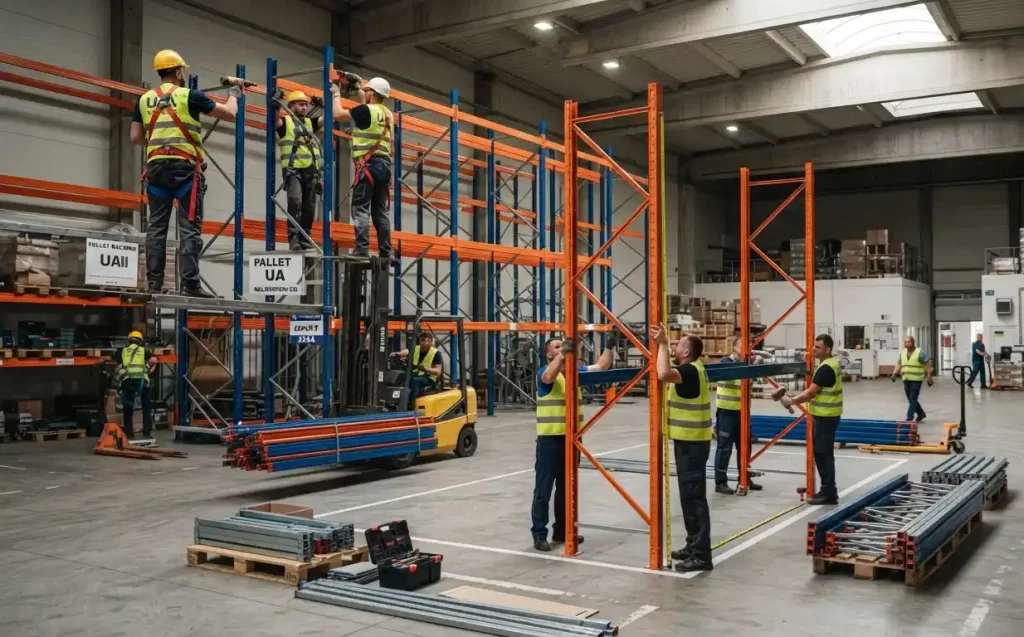
Warehouse Racking Installation If you’ve ever walked through a busy warehouse in Jebel Ali or Dubai Industrial City, you’ve probably noticed the racking without really thinking about it — rows of steel disappearing toward the ceiling, forklifts weaving between them, pallets stacked three or four levels high. Nobody looks up and worries about it. But that’s exactly the point. Good racking work is invisible. It’s only when something’s wrong that everyone suddenly notices.
Here’s the thing most people outside the industry don’t realize: racking isn’t furniture. It’s a structural system. And in the UAE, where warehouses are expanding, relocating, and reconfiguring constantly to keep up with logistics demand, the way that system gets installed, moved, or taken down really does matter — for safety, for cost, and honestly for how smoothly the whole operation runs.
Why You Can’t Just “Warehouse Racking Installation
At a glance, racking seems straightforward. Uprights go in, beams lock across, pallets go on top. Simple, right? Except a fully loaded rack is carrying serious weight, and small mistakes compound fast. A beam that isn’t fully seated. An upright that’s a few degrees off plumb. Anchors that weren’t matched to the actual floor conditions. None of these look like a big deal on installation day — until months later when something shifts or gives way, usually with a warehouse full of workers nearby.
That’s why the real work happens before anyone touches a bolt. A competent team walks the site first. They look at floor load capacity, ceiling clearance, fire safety requirements, and — this part gets skipped more than it should — what’s actually going to sit on those shelves. Racking built for dry palletized goods is a different animal than racking meant for a cold store or for hazardous materials. Skip this step and you’ll likely end up either overbuilding (wasting money) or underbuilding (creating a hazard), and neither is a good place to be.
Then comes the actual installation: getting every frame level and square, torquing bolted connections to spec, anchoring base plates properly into the slab. It sounds tedious because it is tedious — and that’s the point. The good contractors in the UAE also make sure everything lines up with local codes and international racking standards, and they’ll hand over documentation afterward so you’ve got a record for audits or insurance down the line. If a provider can’t show you that kind of paperwork, that’s worth noticing.
Racking Relocation Is Where Things Get Genuinely Tricky
You’d be surprised how often UAE businesses move racking around. A company outgrows its current space, or a better logistics location opens up, or the product mix changes and the whole layout needs rethinking. Whatever the reason, relocation ends up being trickier than a fresh install in a lot of ways — because now you’re dealing with used, sometimes years-old, structural components.
Taking a system apart without wrecking the parts, hauling it somewhere new, and rebuilding it in a configuration that’s often not identical to the original — that’s the job. A team that knows what they’re doing will inspect every single piece along the way. Years of forklifts clipping uprights, minor impacts, corrosion from humidity — a lot of that damage is easy to miss until you actually look closely. A bent frame or a hairline crack in a weld might’ve been fine sitting in place for years, but reload it in a new spot and it’s a different story. The rule here is simple: if something looks questionable, replace it. Don’t gamble on it.
And then there’s timing. Most warehouses can’t just shut their doors for two weeks while racking gets moved — the business still has to run. So relocation usually happens in stages, one section at a time, while the rest of the facility keeps operating around it. That takes planning, constant communication with the warehouse floor staff, and a crew that can roll with whatever comes up — because something always does when you’re working around live operations.
Racking Dismantling Isn’t the “Easy” Job
There’s a tendency to treat dismantling as the low-effort part of the process — just take it apart, right? That mindset is actually where a lot of accidents happen. Racking has to be cleared of stock first, and the structure needs to come down in the right order, because pulling out the wrong section first can destabilize everything next to it. Rushed, careless dismantling is one of the more common causes of injury in warehouse work, and it’s almost always avoidable with a bit of planning.
A good crew also thinks past the demolition itself. Steel that’s still in decent shape can often be resold or reused elsewhere, or at least recycled properly instead of dumped. It’s better for the client’s wallet and better for the environment, and it leaves the site actually usable afterward — whether that means new racking goes in, different equipment moves in, or the space gets repurposed entirely.
What Actually Matters When Choosing a Contractor
Price is tempting to lead with, but it shouldn’t be the only thing you’re weighing. Look for trained riggers, proper lifting equipment, real insurance coverage, and a portfolio of projects that actually resemble the scale of yours. A serious provider will want to visit your site before quoting anything, will give you a clear written scope, and can explain — not just claim — how they calculate load capacity and how they stay compliant with UAE safety regulations.
One more thing worth asking about: do they offer inspections after the job’s done? Racking damage tends to creep up quietly — a slightly bent beam here, a loosened bolt there — and it often goes unnoticed until something fails. Providers who build ongoing inspection into their service tend to be the ones who actually care about long-term safety, not just getting the install finished and moving on.
Sama Racking Professional Warehouse Racking Installation: racking Relocation and Dismantling in UAE
Bottom Line
Nobody walks into a warehouse and admires the racking. That’s fine — it’s not supposed to be the star of the show. But it’s quietly holding up almost everything else that happens on that floor, every single day. Get it wrong and you’re looking at safety risks, damaged inventory, and expensive downtime. Get it right, and it just fades into the background, doing exactly what it’s supposed to do. In a market moving as fast as the UAE’s logistics sector, that reliability isn’t a luxury — it’s the foundation everything else gets built on.
Sama Racking Professional Warehouse Racking Installation, Racking Relocation and Racking Dismantling in UAE
contact +9710544812988 / Email: info@samaracking.ae
