
Warehouse Racking in Dubai
If you’re setting up or expanding a warehouse in Dubai, racking probably isn’t the most exciting part of the process. It’s easy to treat it as an afterthought — something to sort out once the building, the leases, and the staffing are locked in. But racking is actually one of the decisions that quietly shapes everything else: how much stock you can hold, how fast your team can pick orders, and how safely your warehouse runs day to day.
Dubai’s logistics sector has grown fast, and with that growth comes pressure to move quickly. Unfortunately, speed is exactly what leads to racking mistakes. Here are the five most common ones we see, and what to do instead.
1. Designing for Today’s Stock, Not Tomorrow’s
A lot of businesses size their Warehouse Racking in Dubai around current inventory levels. It feels efficient — why pay for space you don’t need yet? The problem is that Dubai’s trade volumes shift quickly, especially for businesses tied to e-commerce, re-export, or seasonal goods like electronics and textiles.
Six months after installation, many warehouses find themselves either overflowing or renting expensive overflow space nearby. A better approach is to plan racking around your growth projections for the next two to three years, not just your opening-day inventory. Even leaving 15–20% flexible capacity can save you a costly redesign later.
2. Ignoring Building and Site Constraints
Warehouse Racking in Dubai in areas like Jebel Ali, Al Quoz, or Dubai Investment Park often come with specific structural quirks — column spacing, floor load limits, ceiling height restrictions, and fire safety clearances that vary depending on the facility. Some operators order racking systems based on generic layouts without first getting an accurate site survey.
The result is racking that doesn’t fit properly, blocks sprinkler coverage, or wastes vertical space because nobody checked the real ceiling height against UAE Civil Defence requirements. Before ordering anything, get a proper site audit done — including floor load capacity, since Dubai’s warehouse floors aren’t all built to the same standard.
3. Choosing the Wrong Racking Type for the Product Mix
Selective pallet racking is the default choice for many warehouses, and it works well for a wide range of goods. But it isn’t automatically the right fit for every operation. A business handling fast-moving consumer goods with high SKU turnover might benefit more from drive-in or push-back racking, while a 3PL handling varied pallet sizes might need a mixed system with narrow-aisle racking to maximize density.
Choosing racking based on what a competitor uses, or simply what’s cheapest upfront, often backfires once operations begin. Match the racking type to your actual picking frequency, pallet variety, and order profile — not just to your budget line.
4. Warehouse Racking in Dubai Overlooking UAE Safety and Compliance Standards
This is one of the more serious mistakes, and one that gets overlooked more often than it should. Racking systems in the UAE need to meet structural safety standards, and installations should be signed off by a qualified engineer, particularly for taller systems or high-density storage.
Some businesses skip proper load-rating documentation or install racking without regular inspection schedules, which becomes a liability issue if there’s ever an accident or an insurance claim. Make sure your racking supplier provides load capacity certificates, and build in a routine inspection schedule — most safety consultants recommend at least an annual structural check, with more frequent visual inspections by warehouse staff.
5. Underestimating Aisle Width and Equipment Compatibility
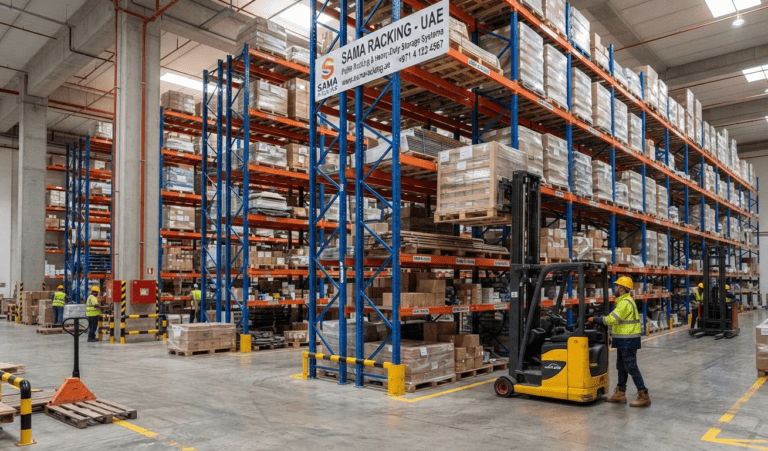
It’s surprisingly common for Warehouse Racking in Dubai layouts to be finalized before anyone confirms what forklifts or reach trucks will actually be operating in the aisles. Narrow-aisle racking looks great on paper because it increases storage density, but if your equipment can’t maneuver safely within that space, you end up with slower operations, more product damage, and higher accident risk.
Before finalizing your layout, confirm turning radius and mast height for your actual fleet — not a generic assumption. If you’re planning to scale up with different equipment later, build that flexibility into your aisle widths now rather than retrofitting afterward.
Getting It Right the First Time
Warehouse Racking in Dubai mistakes are expensive to fix after installation — not just in materials, but in downtime while a warehouse is reconfigured. The businesses that avoid these problems are usually the ones that treat racking planning as its own project, with a proper site survey, a clear picture of future growth, and input from both a structural engineer and the team who will actually be working the floor every day.
If you’re in the planning stage, it’s worth slowing down at this one step. A few extra weeks spent getting the layout right can save months of disruption once the warehouse is liv